|
| |
|
Did you know?
Tigers like mountains
In 2008, in Bhutan, footprints and photographs of tigers showed that this predator can be found between 3,700 and 4,300 meters. Previously it was thought that tigers couldn’t be found beyond 3,000 meters. It could be that tigers have always lived at these heights but they had just never before been observed.
|
| |
|
Let’s hope |
|
Zoos mobilized in European breeding programs (EEP)
In order to keep the species alive over the long term, zoos are organizing themselves to maintain genetic variability of captive specimens. The Siberian and Sumatran tigers are the object of a European breeding program (EEP).
These two sub-species, along with the Indochinese sub-species, are part of an American program for endangered species (SSP).
The tiger reproduces very well in captivity. It’s likely that there are more tigers in captivity than wild tigers, if we count the tigers produced by hybridization between subspecies.
| |
 |
|
| |
|
|
|
|
| |
Scientific name :
Panthera tigris
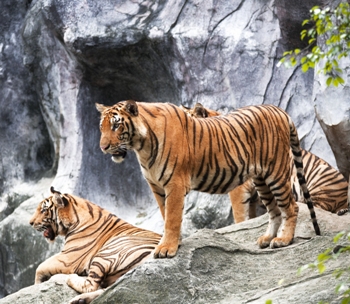
The tiger is the biggest wild feline and one of the biggest carnivores in the world. It’s also the only one with a striped coat. The species is made up of nine sub-species that feature minor differences in size or behavior.
The tiger is an excellent swimmer. It can easily cross waterways that are 6 to 8 kilometers wide. The record is held by a Sumatran tiger that crossed a 29-km-wide sound.
|
| |
 |

| |
Where does it live?
In the Eurasian tropical forests, from Russia to Korea, by way of China and India.
| |
| |
 |
|
| |
|
Key figures |
It eats 6kg of meat per day.
Its claws can measure up to 10 cm long!
It can eat 14 to 40 kg of meat at a time!
Maximum speed: 50km/h
2 or 3 offspring per litter
Gestation: almost 100 days
The lifespan of a tiger is 25 years in captivity versus 15 years in the wild.
| |
 |
|
| |
|