|
| |
|
Did you know?
The hotter it gets, the higher it climbs
At the end of winter, the black bear starts looking for food in the mountains. As summer arrives, it climbs to higher altitudes. This is probably a way for it to cope with summer heat!
|
| |
|
Let’s hope |
|
Living together in a better way
In Canada, the Minister of Natural Riches in Ontario established an information program to better educate people about black bears. It’s based on understanding the animal in order to react better in the presence of a bear. In fact, black bears are increasingly approaching areas where people are living. “We want bears to stay wild, and humans to be safe.” A simple act to begin with: closing garbage cans hermetically!
| |
 |
|
| |
|
|
|
|
| |
Scientific name :
Ursus americanus
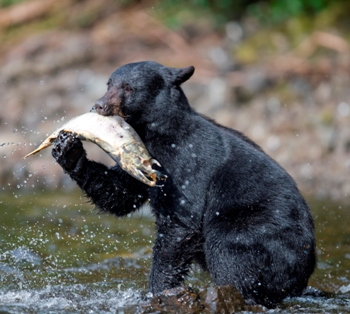
Contrary to what its name indicates, the black bear is not necessarily black. Its fur can be light, brown and even spotted. This animal is most often found alone.
Bears are surprisingly agile in their movements. They climb trees easily to escape danger, thanks to their powerful dorsal muscles and claws. It’s also an excellent swimmer and is capable of crossing a lake to get to an island.
It lives in habitats that are generally in northern forested or mountainous (from 900 to 3,000m altitude) areas and even, in certain cases, in wet forests, in swampy zones or in tundras. The forest is a favorable environment for this bear: it can hide and protect itself from the sun.
The black bear is one of the most intelligent mammals: its brain is relatively big compared to the size of its body.
|
| |
 |

| |
Where does it live?
In forests in Alaska, Canada, the United States and northern Mexico.
| |
| |
 |
|
| |
|
Key figures |
2 meters long
Gestation: 6 to 7 months
Birth weight: 400 kg
Average lifespan: 15 years in wild
75% of its alimentation is plant-based
It loses up to 30% of its mass during winter
It can run up to 55km/h
| |
 |
|
| |
|